For much of biomethane’s recent expansion in Brazil, the central question has been one of potential. How much could the country produce from agricultural, agro-industrial, municipal and sanitation waste? In which regions would this resource be available? Which sectors could replace natural gas, diesel or other fossil fuels with biomethane?
These questions remain relevant, but as the market develops, a different set of challenges is beginning to demand answers. Producing biomethane is only one stage in a chain that must deliver the molecule to consumers, verify its characteristics, identify its origin and create the conditions for its decarbonization attributes to be recognized economically.
The agenda at ROG.e 2026, held in Rio de Janeiro from September 21 to 24, made this shift particularly visible. Over the course of just a few days, the programs of the Energy Research Office, EPE, and the National Agency of Petroleum, Natural Gas and Biofuels, ANP, brought together discussions on gas and biomethane infrastructure, advanced biofuels, ten-year energy planning, low-carbon fuels, certification, carbon intensity and the National Decarbonization Program for Natural Gas Producers and Importers.
The most significant point does not lie in any of these initiatives individually. It lies in the way they are beginning to connect.
The biomethane debate is moving beyond a supply-focused agenda and becoming a system-wide discussion. This involves production, but also gathering, processing where applicable, transportation, connection to existing infrastructure, demand, certification, registration and regulatory instruments capable of linking the renewable molecule to emissions reductions.
In other words, the market is beginning to move away from the question “how much can Brazil produce?” toward a more difficult one: how can this potential be transformed into economically accessible, traceable supply that is effectively connected to consumers?
Integrated planning began to take shape before ROG.e
The presentation held this week is the result of a process that began years earlier.
In March 2023, through CNPE Resolution No. 1, the National Energy Policy Council established the working group for the Gas to Employ Program, known as Gás para Empregar. Among its objectives was the development of studies aimed at improving the use of gas produced in Brazil and discussing the expansion and operation of the country’s infrastructure.
The next step came in 2024. Decree No. 12,153 created the National Integrated Plan for Natural Gas and Biomethane Infrastructure, PNIIGB, assigning EPE the task of developing a planning framework that would address supply, demand and infrastructure in a coordinated manner.
The very definition of the plan already represents an important shift for biomethane.
According to EPE’s official PNIIGB page, the plan covers natural gas gathering, processing, storage and transportation facilities, distribution using compressed natural gas, CNG, or liquefied natural gas, LNG, as well as biomethane production facilities and the subsequent transportation of biomethane.
This means biomethane is now being analyzed as part of a broader infrastructure architecture, rather than solely as a fuel produced through decentralized facilities.
This distinction matters because the geography of biomethane differs from that of conventional natural gas.
Much of its potential is associated with waste generated in areas where agricultural and agro-industrial activities, landfills, wastewater treatment facilities and other operations producing organic material are located. These sources may be far from pipeline networks or from the largest industrial demand centers.
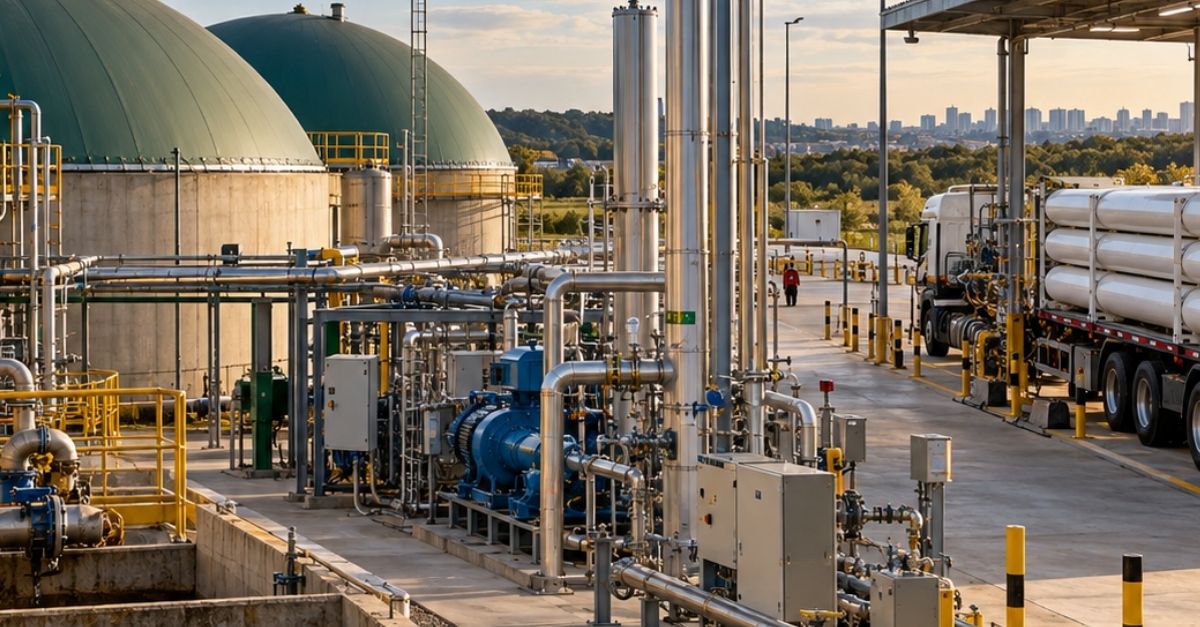
In some cases, a pipeline connection may be economically justified. In others, supply may depend on compression and road transportation, liquefaction or local solutions in which production and consumption are relatively close to one another.
For this reason, simply identifying a region’s energy potential is not enough.
It is necessary to understand how much it costs to deliver that energy to the end user, what infrastructure exists nearby, which routes are technically feasible and where the consumers capable of economically supporting the necessary investments are located.
In 2025, the methodology for turning potential into planning took shape
Throughout 2025, this framework began to take on a defined methodology.
Between March and April, EPE submitted the PNIIGB methodology for public consultation. The work began to consider not only an assessment of existing infrastructure, but also forecasts of natural gas and biomethane supply and demand, project selection, socio-environmental analysis, investment estimates and impacts on employment and income.
In August 2025, the agency published the final version of the Methodological Technical Note. The document incorporated the public participation process, which received 148 contributions from 16 industry stakeholders. EPE said the contributions would serve as a basis for the next stage, involving the actual development of the plan.
Another important step was the public call conducted between April and May of that year. Its purpose was to gather information provided directly by market participants in order to estimate effective demand for infrastructure services and identify potential natural gas and biomethane supply and demand.
This approach helps address a recurring challenge in energy planning.
Technical potential does not necessarily translate into commercial supply. Likewise, an estimate of demand does not necessarily mean that a consumer is willing to contract a particular type of infrastructure under the available economic conditions.
By consulting stakeholders, mapping infrastructure and analyzing projects, the planning process seeks to narrow this gap between projections and market reality.
In September 2025, EPE released a version of the PNIIGB for public consultation containing the projects selected for that planning cycle, including their rationale, cost analyses, socio-environmental impacts, connections to existing infrastructure and effects on employment and income.
The document explained that the first version of the plan was emerging at a time when the gas market was undergoing transformation and decarbonization policies were advancing, creating the need for an instrument that moved beyond isolated project analysis and began to assess the industry in an integrated manner.
It is precisely this logic that makes the PNIIGB particularly relevant to biomethane.
September 22: gas and biomethane infrastructure return to the center of the debate
On Tuesday, September 22, 2026, the discussion reached ROG.e.
At 4:50 p.m., EPE presented the methodology and impacts of the National Integrated Plan for Natural Gas and Biomethane Infrastructure during a technical session dedicated to planning, governance and the institutional organization of the market. The presentation was delivered by analyst Henrique Rangel of the Oil and Natural Gas Department.
Although the program released by EPE had not, as of the publication of this article, provided new detailed quantitative results from the presentation, the presence of the PNIIGB in the industry debate reinforces a movement that has been developing since 2024: biomethane is no longer being treated merely as an alternative source of production and is becoming part of Brazil’s gas infrastructure planning.
This shift may appear technical, but it has important economic consequences.
A plant may produce fuel that meets the quality requirements for industrial, commercial or vehicle use and still struggle to access a competitive market if it is geographically distant from demand.
Connection costs can completely change the economics of a project.
In certain regions, the challenge may involve building a lateral pipeline to the existing network. In others, it may be necessary to establish CNG or Bio-LNG logistics. There are also situations in which the best solution may be to bring consumption closer to production, creating regional markets or contracts directly linked to specific industrial facilities.
Infrastructure therefore ceases to be a stage considered only after an investment decision and becomes part of the feasibility assessment itself.
This is similar to a shift already occurring in other segments of the energy transition. The availability of a natural resource alone does not create a market. Infrastructure is needed to bring supply and demand together.
In the power sector, this debate emerges through the need for transmission and distribution networks capable of integrating renewable generation. In biomethane, it takes the form of pipelines, interconnection facilities, compression, liquefaction, transportation and territorial planning.
The value of the PNIIGB lies precisely in bringing two different geographies closer together
Potential biomethane supply is distributed according to the location of biomass and waste resources. Demand, however, follows a different geography.
Energy-intensive industries, heavy-duty fleets, chemical plants, piped gas networks and commercial consumers are concentrated along specific economic corridors. They are not always located near the regions with the greatest availability of feedstocks for biogas production.
This geographic mismatch helps explain why integrated planning can play a strategic role.
This does not mean assuming that every producer needs access to a pipeline. The official design of the PNIIGB itself includes different transportation and distribution alternatives. The goal is to identify the situations in which each solution makes sense and where shared infrastructure can reduce costs, increase scale and provide access to new markets.
This type of coordination can be particularly relevant in regions with several potential producers.
Projects that are relatively small on an individual basis may struggle to justify major logistics investments. When analyzed as part of a regional hub, however, the economics can change.
At the same time, planning must avoid the opposite problem: building infrastructure based solely on theoretical potential that does not translate into contracts, projects or actual demand.
This is why EPE’s methodology combines forecasting, information provided by industry participants, cost estimates, socio-environmental analysis and impact assessments.
The challenge is not simply to expand infrastructure.
It is to build the right infrastructure, in the right place and at a pace consistent with the actual development of supply and demand.
September 23: advanced biofuels enter the broader energy transition debate
The following day’s program broadened the discussion.
On Wednesday, September 23, EPE presented the study “Advanced Biofuels and the Energy Transition in Brazil: Socioeconomic Perspectives Using the Input-Output Matrix” at ROG.e, as part of the thematic session on Bioenergy and Bioproducts. On the same day, the institution participated in discussions on energy integration, projections and planning, while also holding a technical session dedicated to the Ten-Year Energy Expansion Plan.
The published program does not provide sufficient information to attribute results or projections to the study that have not been formally released, but the combination of topics is significant.
Biofuels are increasingly being assessed not as an isolated segment, but as one of several instruments within a diversified energy transition.
This makes sense in the Brazilian context.
Unlike economies where decarbonization is heavily concentrated on replacing fossil-fuel-based power generation, Brazil already has a high share of renewables in its electricity mix. A significant portion of its future challenges lies in transportation, industry and thermal applications where renewable molecules can play an important role.
The PDE 2035 is itself an integrated planning instrument, prepared by EPE under the coordination of the Ministry of Mines and Energy, which analyzes different energy sources and their expansion prospects over the 2026 to 2035 horizon. Among its components, the plan includes specific studies on natural gas and biofuel supply.
Biomethane occupies a distinctive position within this integration.
It is a biofuel, but it can also make use of part of the logic and infrastructure of the gas market. It can be produced from waste, used in transportation, replace fossil gas in industrial processes and, depending on the conditions of each project, be transported through pipelines or dedicated transportation systems.
This characteristic helps explain why the fuel appears simultaneously in discussions involving bioenergy, gas, decarbonization and infrastructure.
Physical planning is advancing as the market develops a regulatory architecture
While EPE works on the physical and economic dimensions of infrastructure, another transformation has been taking place on the regulatory front.
Law No. 14,993, enacted in October 2024 and known as the Fuel of the Future Law, established the National Decarbonization Program for Natural Gas Producers and Importers and the Biomethane Incentive Program.
Regulation advanced in 2025 and, in February 2026, ANP’s Board approved two key rules for its implementation. Published on March 4, ANP Resolutions No. 995 and No. 996 address, respectively, the allocation of mandatory targets among natural gas producers and importers and the certification framework required for the issuance of the Biomethane Guarantee of Origin Certificate, or CGOB.
The CGOB adds a new dimension to the market.
According to ANP, the certificate is a traceability instrument associated with the volume of biomethane produced and sold. It certifies characteristics of the production process and must include, among other information, the origin of the feedstock used and the location of production.
The relevance of this mechanism goes beyond demonstrating that a particular molecule is renewable.
In decarbonization markets, information itself acquires value.
Knowing where the fuel came from, how it was produced and which commercial transaction supports the issuance of a particular certificate becomes necessary to prevent double counting, demonstrate compliance with obligations and allow different market participants to recognize the environmental attributes associated with the product.
In this respect, infrastructure and certification address different but complementary problems.
The former allows energy to move physically through the system. The latter allows specific environmental characteristics associated with that energy to be traced within a regulated framework.
In 2026, the CGOB moved from a regulatory concept to an operational framework
The regulations published in March established a chain of market participants and procedures.
For a certificate to be issued, the participating production unit must undergo certification. Origin Certification Agents are accredited by ANP to conduct this process. The regulations also provide for book-entry agents and registration entities, creating an architecture for the issuance, transfer, registration, use for target compliance and retirement of certificates.
According to ANP, the registration entity must maintain CGOB records on an integrated electronic platform, making it possible to trace issuance, transfers, cancellation for compliance with targets and the retirement of certificates.
The agency also established requirements for creating the underlying evidence needed to issue certificates, as well as procedures related to tax documentation used to verify the volumes sold.
There is a reason for this level of detail.
When an environmental attribute becomes a tradable instrument or is used to demonstrate regulatory compliance, its credibility depends on the quality of the information supporting its issuance.
In this context, traceability is not simply an additional bureaucratic requirement.
It is part of the market’s institutional infrastructure.
The first PNDG target made the economic mechanism concrete
In April 2026, the National Energy Policy Council established the program’s first target.
For 2026, a target was set to reduce emissions in the natural gas market by 0.5%, to be met by producers and importers through the participation of biomethane. ANP was given responsibility for allocating the obligations among regulated entities.
Resolution No. 995 establishes which companies are subject to the targets and how those targets will be calculated. Among its provisions, ANP exempted entities with average annual production or imports of 160,000 cubic meters per day or less and established that compliance with an individual target is demonstrated through the cancellation of the corresponding CGOB registration.
This mechanism is important because it creates a bridge between climate policy and demand for biomethane’s environmental attributes.
Previously, a producer essentially needed to find a consumer willing to purchase the renewable molecule.
Under the PNDG, there is now also a regulatory obligation related to decarbonizing the gas market. In practice, this is likely to increase the importance of certified biomethane availability and of instruments capable of demonstrating its use within the established rules.
This does not mean that the market’s challenges have automatically been resolved.
Supply, price, regional availability, infrastructure and transportation costs will continue to determine the market’s ability to expand. But demand is no longer dependent exclusively on voluntary decisions by consumers.
It is precisely at this point that the regulatory agenda and the PNIIGB begin to intersect.
A target can create economic demand for biomethane. For supply to respond, production must increase. And for that production to reach the market, connection, logistics and infrastructure issues must be addressed.
Origin, traceability and carbon intensity move to the center of the agenda
The program for Thursday, September 24, at ROG.e makes this convergence even clearer.
In the morning, the official agenda included discussions on sustainable fuels, biorefining and low-carbon molecules, as well as a session on certification, chains of custody and sustainability assessment.
At 3 p.m., ANP scheduled the presentation “CS SAF: connecting sustainability, carbon intensity and emissions reductions.” Immediately afterward, from 4 p.m. to 5 p.m., the session “ANP’s Role in the National Decarbonization Program for Natural Gas Producers and Importers: Regulatory Challenges and Implementation of the Biomethane Guarantee of Origin Certificate” was scheduled to take place, led by the agency’s Technology and Environment Department.
As of the completion of this article, the latter presentation had not yet taken place. For this reason, any announcements related to schedules, new procedures, operational implementation or changes to the CGOB are not included in this article.
What can already be stated is that the choice of topics itself shows where the debate is heading.
Decarbonization is no longer being approached solely in terms of the volume of renewable fuel placed on the market. Increasing importance is being placed on knowing where the fuel comes from, how its production was certified, which chain of custody supports a given attribute and how to prevent the same environmental benefit from being counted more than once.
This development brings biomethane into line with a broader trend across low-carbon energy value chains.
As companies adopt climate targets and governments establish decarbonization policies, the ability to substantiate environmental attributes becomes increasingly important.
CGOB and CBIO are not the same thing
The expansion of environmental instruments also requires care to avoid conflating mechanisms that serve different purposes.
Biomethane can already participate in RenovaBio, Brazil’s national biofuels policy established in 2017. Under this system, producers and importers undergo energy and environmental efficiency certification and receive an Energy and Environmental Efficiency Score related to the carbon intensity of their production process. This certification is used to calculate the potential generation of Decarbonization Credits, or CBIOs.
Each CBIO represents one metric ton of carbon dioxide equivalent emissions avoided under the program’s methodology and is used to meet the decarbonization targets assigned to fuel distributors.
The CGOB serves a different purpose.
It is linked to the origin and traceability of biomethane within the natural gas market decarbonization program.
The two instruments are therefore both part of Brazil’s emissions-reduction policy, but they should not be treated as equivalent.
ANP itself conducted a specific study on the fungibility of CGOBs and other environmental attribute certificates. The technical report was approved by the agency’s Board in June 2026, demonstrating that the relationship between different instruments requires its own regulatory analysis.
This distinction is important because a more sophisticated market will depend precisely on the ability to identify which attribute is being traded or used to meet a specific obligation.
September 24: RenovaBio opens a new biomethane certification process
On the same Thursday, another regulatory development helps complete the picture.
ANP opened Public Consultation No. 1051/2026, concerning the proposed RenovaBio certification of Biometano Santa Cruz Ltda. The consultation period runs from September 24 to October 24, with Instituto Totum acting as the inspection firm.
It is important to understand what this consultation represents.
This is not a public consultation intended to change RenovaBio’s general rules. It is one stage in the certification process for a specific producer.
ANP explains that these consultations make the process public and allow members of society and interested stakeholders to submit comments on the certification. After the public consultation period, the inspection firm reviews the comments received and may conduct additional verification before a decision is made on the process.
Once the Efficient Biofuel Production Certificate is approved, the certified producer may become a primary issuer of CBIOs, in a quantity linked to the eligible volume sold and the environmental efficiency recognized through the certification process.
Taken in isolation, the consultation involving a single company does not represent a structural change in the market.
Its significance lies in the overlap between different policy agendas.
While Brazil is establishing a specific certificate of origin for biomethane under the PNDG, producers of the same molecule continue to advance through RenovaBio’s environmental certification system.
Biomethane is therefore beginning to occupy multiple regulatory frameworks at the same time.
The next challenge will be making infrastructure, regulation and economics work together
The sequence of developments between September 22 and 24 provides a more complete picture of Brazil’s biomethane market.
In the first development, the PNIIGB brings the fuel into gas infrastructure planning and places gathering, transportation and connection issues at the center of market expansion.
In the second, discussions on advanced biofuels and ten-year energy planning reinforce the role of bioenergy as part of a broader energy strategy.
In the third, the PNDG and CGOB establish regulatory demand, certification and traceability.
Finally, the new RenovaBio consultation shows that certification of biomethane producers’ environmental efficiency is continuing to advance in parallel.
Together, these initiatives point to an important shift in market maturity.
The Brazilian market is no longer discussing only whether production potential exists.
The question is becoming whether that potential can be transformed into molecules available to actual consumers, supported by economically viable logistics, regulated quality, verifiable origin and reliable mechanisms for recognizing their environmental benefits.
This transition increases the complexity of the sector, but it also creates the foundations required for its expansion.
An energy market cannot be sustained by technical potential alone. It requires demand, infrastructure, standards, contracts, regulatory confidence and mechanisms capable of reducing information asymmetries between producers and consumers. The PNIIGB addresses part of this challenge by seeking to organize the physical dimension. The PNDG and CGOB address the regulatory and traceability dimensions.
RenovaBio adds an already established mechanism for measuring energy and environmental efficiency and generating decarbonization credits. The development of biomethane will increasingly depend on the ability of these different pieces to work coherently together.
Production is only the beginning of the equation
Brazil has significant conditions for developing biomethane. The country has agricultural and agro-industrial waste resources, major animal protein supply chains, sugar and ethanol production, landfills, sanitation systems and consumers that currently use natural gas or fossil fuels and may seek lower-carbon alternatives.
But potential is not the same as a market.
Between organic material and the end consumer lies a chain of technical and economic decisions.
Biogas must be produced and upgraded until it meets the applicable biomethane specifications. Quality must be ensured, buyers must be found and decisions must be made about how to transport the molecule. Depending on the project, it may be necessary to build dedicated infrastructure, access an existing network or use compressed or liquefied transportation.
In addition, a decarbonization market requires the environmental attributes of that production to be demonstrated reliably.
This is where the developments of this week become meaningful when viewed together.
The PNIIGB presentation shows that gathering and connection are beginning to become part of biomethane development policy. The PNDG agenda shows that there will be regulatory demand associated with decarbonizing the gas market. The CGOB creates a framework for verifying origin and tracing certificates. RenovaBio continues to provide a specific mechanism for measuring environmental efficiency and generating CBIOs.
None of these instruments, taken individually, guarantees the expansion of the sector.
Together, however, they show that the Brazilian debate is beginning to move beyond a phase dominated primarily by discussions of potential and into another, more difficult and more concrete phase focused on the actual formation of a market.
The challenge facing biomethane is therefore beginning to change.
Production remains fundamental. However, the next stage will be defined by the ability to connect production and consumption, reduce logistics costs, develop infrastructure, verify origin and transform environmental attributes into reliable economic signals.
It is at this point that energy planning, infrastructure and decarbonization policy cease to move along separate tracks.
And it is also at this point that biomethane can begin to move beyond being merely a potential opportunity within Brazil’s energy transition and take on a more structured role within the country’s energy system.