The paradox that will define the future of global energy.
The world must reduce CO2 emissions by 30 to 50% by 2030 while simultaneously increasing electricity generation by at least 40% by 2035. These two goals must move forward together, yet they are still progressing at opposite speeds. The paradox is not climate rhetoric. It is the central challenge documented by the study Back to 2050, from the Schneider Electric Sustainability Research Institute, and by the World Energy Outlook 2025 from the International Energy Agency (IEA). Understand what is at stake, how we got here, what the main agreements and laws determine, and why Brazil could play a leading role.
The context: why energy and climate have collided now
The energy transition has existed for decades as a concept, but it became an operational urgency after two key moments. The first was the signing of the Paris Agreement in 2015, which committed 196 countries to limit global warming to 1.5 degrees Celsius above pre-industrial levels. The second was COP28 in Dubai (2023), where for the first time a multilateral text agreed on the need to transition away from fossil fuels and set the goal of tripling global renewable capacity by 2030, increasing from the current 4,250 GW to at least 11,000 GW.
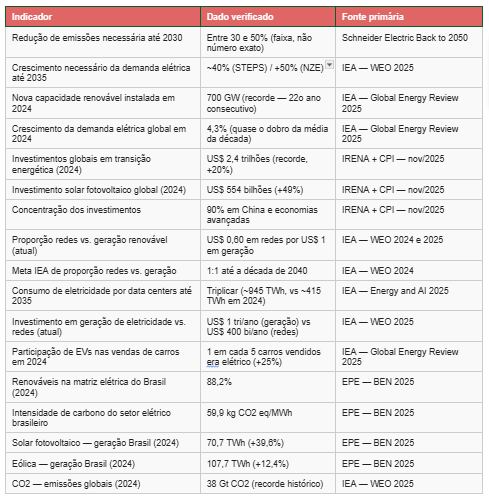
What made the equation more complex was the accelerated growth of global electricity demand, driven by factors that did not exist at the same scale in 2015: the explosion of AI-powered data centers, the electrification of transportation, the rapid industrialization of emerging economies, and consecutive temperature records that increased demand for cooling. According to the IEA Global Energy Review 2025, the electricity sector recorded a 4.3% increase in global demand in 2024, almost twice the annual average of the past decade. A total of 700 GW of new renewable capacity was added, a new record for the 22nd consecutive year, and renewables plus nuclear accounted for 80% of the growth in electricity generation in 2024.
It is within this context that the two numbers summarizing the decade’s challenge emerge: emissions needing to fall by 30 to 50% by 2030 and electricity generation needing to grow by at least 40% by 2035. As highlighted in the Schneider Electric study and confirmed by the IEA scenarios, this is not a contradiction. It is the equation that will determine whether the energy transition succeeds.
What the agreements, laws, and regulatory frameworks say
The global regulatory architecture begins with the Paris Agreement, ratified by Brazil in 2016. The treaty does not establish direct penalties for noncompliance, but it created a system of reputational, financial, and diplomatic pressure that has become increasingly effective. The European Union translated its climate commitment into binding legislation through the Renewable Energy Directive (RED III), which requires 42.5% renewables in the EU’s final energy mix by 2030, with sector-specific targets for industry, transport, and heating.
In the United States, the Inflation Reduction Act (IRA) of 2022 allocated US$369 billion in incentives for clean energy, the largest climate investment in American history, with tax credits for solar, wind, storage, electric vehicles, and energy efficiency. In 2023, the United States installed more than 32 GW of solar capacity, a historic record.
In Brazil, the regulatory framework includes the New Gas Legal Framework (Law 14.134/2021), the Future Fuels Law (Law 14.993/2024), which established mandates for biofuels and biomethane, and the Ten-Year Energy Plan 2035 (PDE 2035), which projects the expansion of more than 50 GW of renewable capacity by the end of the decade. Brazil’s revised NDC in 2023 targets a 48% reduction in greenhouse gas emissions by 2025, 53% by 2030, and net-zero emissions by 2050.
The global regulatory landscape converges toward a consensus: clean electricity is the central vector of decarbonization, and power grids must be modernized, expanded, and made intelligent to support this transition.
The equation in numbers: fewer emissions, much more electricity
The Back to 2050 study from the Schneider Electric Sustainability Research Institute establishes that, to keep global warming within the 1.5 degree Celsius limit set by the Paris Agreement, CO2 emissions must be reduced by 30 to 50% by 2030 and reach net zero by 2050. The study emphasizes that more than half of the required reductions will come from changes on the demand side, with energy efficiency acting as the “first fuel” of the transition.
At the same time, the IEA World Energy Outlook 2025 documents that global electricity demand will grow by about 40% by 2035 under the STEPS scenario (Stated Policies) and by more than 50% under the NZE scenario (Net Zero 2050). The drivers are clear. The IEA projects that electricity consumption by data centers could triple by 2035, reaching approximately 945 TWh compared with about 415 TWh in 2024, according to the report Energy and AI. Transport electrification is also accelerating. In 2024, one in five cars sold worldwide was electric, with sales growing more than 25% compared with 2023.
The scale of the required investment is equally striking. In 2024, global investments in the energy transition reached a record US$2.4 trillion, a 20% increase compared with the average of the previous two years, according to a joint report from IRENA and the Climate Policy Initiative (CPI) published in November 2025. Of that total, US$807 billion went to renewable technologies, including US$554 billion for solar photovoltaics alone, a 49% increase. A critical warning is that 90% of these investments were concentrated in advanced economies and China, leaving developing countries with limited access to transition capital.
The bottleneck few want to see: power grids falling behind
There is one IEA figure that should appear in every national energy plan: for every dollar invested in renewable generation, only 60 cents are allocated to electricity grids and storage. The agency is clear that this imbalance must be corrected to a 1:1 ratio before the 2040s for power sector decarbonization to occur safely. While investment in generation has grown nearly 70% since 2015 to US$1 trillion per year, spending on grids has increased at less than half that pace, reaching US$400 billion annually, according to the IEA WEO 2025.
The consequences are already visible in the form of transmission congestion, queues of wind and solar projects waiting for connection, and curtailment, the forced reduction of clean generation due to insufficient transmission capacity. In Brazil, curtailment reached its highest historical level in January 2026, with 2.86 TWh of curtailed energy, a 45% increase compared with December 2025, according to data from ePowerBay.
Modernizing grids requires three simultaneous pillars: digitalization with sensors, automation, and real-time intelligent management; energy storage, particularly large-scale batteries whose costs continue to decline; and demand flexibility, allowing large consumers to adjust their consumption according to renewable energy availability, reducing peaks and improving system efficiency.
Brazil at the center of the paradox: real advantages and urgent challenges
Brazil occupies a unique position in the global context. In 2024, 88.2% of the country’s electricity mix came from renewable sources, according to the National Energy Balance 2025 (BEN 2025) from EPE. Brazil’s power sector emitted only 59.9 kg CO2 eq per MWh in 2024, about four times less than OECD European countries and ten times less than China. Solar generation grew 39.6%, reaching 70.7 TWh, and wind generation reached 107.7 TWh. Together, solar and wind already represent 23.7% of all electricity generation in the country.
On the industrial front, a study conducted by Schneider Electric in partnership with Brazil’s Ministry of Development, Industry, Trade and Services (MDIC) and the consultancy Systemiq, released during COP30 in Belém, projects that Brazil could reduce industrial emissions by up to 60% by 2050 under a high-ambition scenario, with the potential to create up to 760,000 jobs in the bioenergy sector by 2030. According to the study, this would require coordinated policies in infrastructure, financing, and workforce training.
The challenges are concrete and urgent. Curtailment of wind and solar generation is increasing at the same pace as new plants. Transmission and distribution infrastructure modernization requires investments that are still insufficiently planned. Access to credit for clean energy projects faces double-digit interest rates, while European and American countries finance the transition with significantly lower capital costs. And COP30 in Belém in November 2026 places Brazil under international scrutiny that demands concrete results, not only projections.
What must happen by 2030: the concrete agenda
The IEA is direct in its most recent analysis: there is clearly less momentum than before behind national and international efforts to reduce emissions, while climate risks continue to rise. For the goals of the Paris Agreement to remain achievable, four fronts must advance simultaneously.
- Investment in grids and storage: the current ratio of US$0.60 in grid investment for every US$1 in renewable generation must reach 1:1. This requires tripling annual investment in electricity networks from the current US$400 billion to at least US$1.2 trillion per year.
- Energy efficiency as a priority: the Back to 2050 study from Schneider Electric indicates that more than 70% of CO2 can still be removed with technologies already available. Energy efficiency combined with digitalization and electrification could account for half of the emissions reductions needed by 2050.
- Redistribution of investments: the 90% of energy transition investment currently concentrated in advanced economies and China must be redistributed. Emerging countries, including Brazil, hold the largest renewable resources and some of the cleanest energy mixes, yet they access financing at far higher rates. Multilateral mechanisms such as the Just Energy Transition Partnership (JETP) represent concrete steps in this direction.
- Regulation aligned with market speed: in Brazil this means creating a regulatory framework for energy storage, establishing compensation mechanisms for grid flexibility, advancing the opening of the free electricity market to low-voltage consumers, and resolving the curtailment bottleneck with clear compensation rules for generators.
Data Panel: The Global Energy Equation 2024–2040
The Age of Electricity has arrived, but not yet for everyone
The paradox is real, but it is not unsolvable. The history of energy has already experienced equally radical transitions: from coal to oil, from oil to gas. What makes this one different is the speed required and the scale of coordination needed. Reducing emissions by 30 to 50% while increasing electricity generation by 40 or 50% is not a contradiction. It is an equation with only one solution: increasingly clean electricity, increasingly intelligent grids, and increasingly well-directed investment.
Fatih Birol, Executive Director of the IEA, summarized the current scenario when presenting the WEO 2025: there is less momentum than before, but the data shows that the Age of Electricity has truly arrived. The world generated more clean electricity in 2024 than in any other year in history. Yet global emissions also reached a record, totaling 38 gigatons of CO2, the highest level ever recorded.
Brazil holds the most valuable asset in this new world: an electricity mix already largely renewable, abundant natural resources, and an ambitious NDC that positions the country as a key player at COP30 in Belém. But having the asset is not enough. The country must modernize its grids, resolve curtailment, unlock credit, and create regulatory conditions that transform available resources into power plants, jobs, and kilowatts delivered with reliability.
The clock does not negotiate. With every year without coordinated action, the equation becomes harder to solve. And the cost of inaction will not be measured in cents per kilowatt-hour. It will be measured in degrees Celsius.