A debate that goes beyond technology
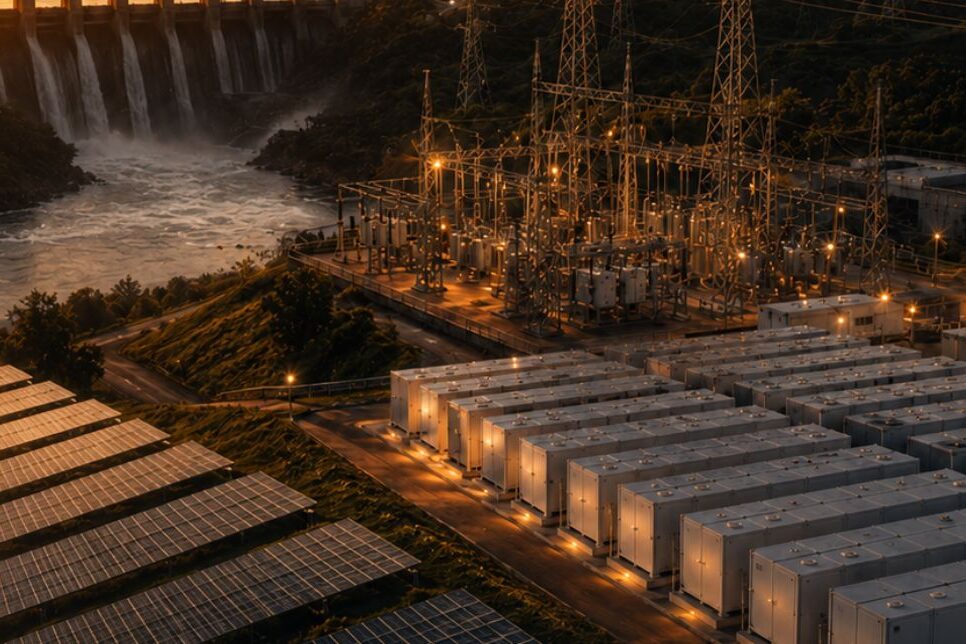
Talking about energy storage in Brazil in 2026 is about much more than batteries and pumped-storage plants. It is about how the regulatory framework of a sector historically structured around generation, transmission, and distribution can—or cannot—absorb technologies that blur these boundaries. ANEEL is at the epicenter of this challenge, and the decisions it makes now will shape the profile of clean energy investment in Brazil for years to come.
The expansion of intermittent renewable sources, especially solar and wind, has made storage a systemic necessity. According to data discussed in a public hearing in the Chamber of Deputies in 2025, the Ten-Year Energy Expansion Plan 2034 (PDE 2034) projects a need for 5,500 MW of additional flexible capacity as early as 2028, reaching more than 35,000 MW by 2034. At the same time, the share of hydropower in the energy mix—historically acting as the system’s natural battery—is expected to fall from 46% to 36% over the same period. This scenario makes not only the deployment of storage systems urgent, but also the creation of a regulatory environment that makes these investments economically viable.
The problem is that the Brazilian power system was designed for assets that either consume or generate energy—never both. A storage system is, by nature, both at the same time, depending on the moment. This functional duality lies at the core of the entire regulatory controversy ANEEL has been facing since the launch of Public Consultation 39/2023.
The regulatory journey: from initial input to legal framework
The process that led to the regulation of storage in Brazil has been long. It began with Public Consultation 011/2020, which received 651 responses from 36 participants between September 2020 and March 2021. This initial consultation mapped the sector’s main challenges and expectations, serving as the foundation for the regulatory agenda that followed.
In October 2023, ANEEL formally launched Public Consultation 39/2023, covering permitting, grid access, tariffs, and sectoral charges for Energy Storage Systems (ESS), including Pumped Storage Hydropower (PSH). The first phase received 831 contributions, and the results were consolidated in Technical Note 266/2024, discussed during ANEEL’s 46th Ordinary Public Board Meeting in December 2024. At that time, the Board approved a second phase, with contributions collected until January 2025, totaling 652 submissions from 70 participants.
In August 2025, ANEEL published Joint Technical Note 13/2025, consolidating the analysis of all contributions and presenting the agency’s technical proposals for ESS regulation. The document marks the conclusion of the first cycle of the storage regulatory roadmap—a structured three-stage plan adopted by ANEEL to address the issue’s cross-cutting complexity.
The next legislative step came with Law 15,269, enacted on November 24, 2025 by Acting President Geraldo Alckmin. Originating from Provisional Measure 1,304/2025, the law is considered the most significant reform of the electricity sector since 2004. Among other provisions, it establishes general guidelines for storage regulation, creates tax incentives for battery systems (BESS), and authorizes the potential reduction to zero of import duties on such equipment. From that point on, storage moved from experimental innovation into formal public policy.
Critical bottlenecks: MUST, TUST, and the dual nature issue
At the heart of the regulatory debate is how to define Transmission System Usage Amounts (MUST) and Distribution System Usage Amounts (MUSD), as well as the applicable Transmission and Distribution Use of System Tariffs (TUST and TUSD) for ESS. This issue carries significant economic and legal weight, as it directly impacts project viability.
ANEEL’s technical proposal for MUST moves toward including ESS capacity within contracted power ranges, but with flexibility. For new installations, the agency allows a reduction of up to 15% in usage amounts, provided the storage system is co-located with a generating plant and specific enforcement measures are adopted, including overrun limits and the installation of a Special Protection System (SPS). This flexibility reflects the logic of peak shaving: storage can reduce peak grid injection and thus contracted capacity demand.
For grid usage contracts (CUST/D), ANEEL adopted a unified approach: co-located generation and storage can be combined into a single Transmission or Distribution Use of System Contract. The goal is to simplify contractual relationships and reduce administrative costs. However, the tension lies in the model’s lack of distinction between power flows—unlike the traditional approach, which separates load and generation contracts, the new proposal integrates them.
In tariff design, ANEEL recommended adopting the so-called dominant profile tariff: the main tariff applied to ESS is determined by the project’s predominant flow—generation or consumption. Any excess beyond the dominant profile is charged under the secondary profile. A system that generates more than it consumes pays a generation tariff as its base, while excess consumption is charged at consumption rates, and vice versa. According to analysis published by Greener, this approach reinforces alignment between tariff incentives and system efficiency by recognizing bidirectional power flows.
The charges issue: is ESS a consumer or a service provider?
One of the most sensitive aspects of the debate is the application of sectoral charges to storage systems. The issue is conceptual before it is technical: ESS consumes energy to store it and later returns it to the system. Is this consumption final use, like a residential customer, or a production input, like fuel for a thermal plant?
The answer has direct implications for charges such as the Energy Development Account (CDE), the Energy Reserve Charge (EER), and PROINFA. If storage is treated as final consumption, these charges apply and reduce investment attractiveness. If treated as an intermediate activity providing system services, the logic points toward exemption.
ANEEL’s Federal Attorney’s Office addressed the issue and, in August 2025, concluded that energy consumed by ESS is not for final use but for system service provision, and therefore should not be considered final consumption for the purpose of typical charges. Based on this interpretation, the agency proposed that charges such as EER, ERCAP, ESS, and PROINFA should not apply to storage services. This decision aligns with the principle of regulatory neutrality and avoids penalizing storage for its operational nature.
However, the issue of CDE-related charges remained under debate, with the Attorney’s Office pointing out the inadequacy of charging them, but final resolution depending on ANEEL’s Board decision. This specific issue led to internal disagreements during the August 2025 Public Meeting, which was ultimately suspended without consensus on certain aspects of grid usage contracting in both load and generation directions.

Co-located or standalone: two worlds, one regulation
Another central axis of regulation is the distinction between co-located ESS—installed alongside generation plants—and standalone ESS operating independently. This distinction is not merely technical: it defines permitting models, tariff regimes, and even market participation.
For co-located ESS, ANEEL proposes incorporating storage into the generation plant’s permit, treating them as a single regulatory entity. For standalone ESS, the issue is more complex. The Federal Attorney’s Office concluded that storage systems are functionally equivalent to generators, leading to a proposal for authorization-based permitting and the creation of a dedicated Energy Storage System Code (ESS code), distinct from the Generation Enterprise Code (CEG).
This choice has important practical consequences. Standalone ESS granted authorization as generators become part of ANEEL’s generation databases and are eligible to participate in CCEE trading mechanisms as Independent Power Producers (IPP). This opens significant commercial opportunities but also imposes typical generation-sector obligations.
For ESS installed at consumer units, ANEEL established that power injection into the grid will not be allowed: contracted injection demand must be set to zero. Exceptions apply to distributed micro- and mini-generation already regulated under Normative Resolution 1,000/2021 and Law 14,300/2022.
The suspended meeting and internal disagreements
On August 11, 2025, ANEEL’s Board held a public meeting to vote on ESS regulation based on Technical Note 13/2025. The outcome surprised the market: due to disagreements among directors—especially regarding grid usage contracting in dual roles as load and generation—the process was suspended without a final vote.
This episode is revealing. It is not merely bureaucratic deadlock; it highlights the deep tension between a bidirectional technology and a regulatory framework built over decades on unidirectional flows. The regulatory coherence required today is not just about harmonizing rules, but about revisiting foundational assumptions.
As noted in analysis by Canal Solar, the main point of tension lies in tariff classification—particularly TUST and TUSD payments, MUST and MUSD contracting, and whether BESS should be classified as load, generation, or a hybrid entity. This debate has constitutional dimensions, involving principles such as isonomy, regulatory neutrality, tariff affordability, and legal certainty—the latter being essential for project financing.
What international experience shows
Brazil is not facing this challenge in isolation. Jurisdictions that moved earlier in storage regulation offer valuable lessons. In the European Union, the 2019 Electricity Directive classified storage as a distinct asset category, separate from generation and consumption, enabling tailored tariff rules. In the United States, FERC Order 841 (2018) ensured storage resources full access to energy, capacity, and ancillary service markets.
In both cases, the key was avoiding the simple extension of legacy rules to hybrid technologies. Instead, new regulatory categories were created, with rights and obligations calibrated to the asset’s nature. This is precisely the challenge ANEEL faces with ESS.
Law 15,269 and what still remains
The approval of Law 15,269/2025 marked a significant step by bringing storage into formal sector policy. The law introduces tax incentives, including the potential inclusion of BESS projects in REIDI and the possible elimination of import duties on batteries and components. It also grants ANEEL explicit authority to regulate and supervise these systems.
However, the law alone does not resolve operational issues. Many rules on grid access, tariffs, charges, revenue stacking, and market participation still depend on ANEEL’s secondary regulation. The agency’s roadmap includes three cycles, with the second focusing on economically sensitive topics such as transmission/distribution integration, behind-the-meter storage, and curtailment mitigation.
Revenue stacking—the ability for a single ESS to monetize multiple services simultaneously—was originally planned for the third cycle, but industry pressure has pushed for earlier treatment. This issue is central to standalone project viability: without clarity on revenue streams, long-term financial structuring remains uncertain.
Coherence as a prerequisite for investment
Ultimately, energy storage regulation in Brazil is a test of institutional maturity. It is not enough for ANEEL to design technically sophisticated rules—they must also be coherent, avoid conflicting incentives, and provide sufficient legal certainty for long-term investments.
The suspended August 2025 meeting is a warning sign. If the agency’s own Board cannot reach consensus on core issues, the market perceives regulatory uncertainty. And for this type of investment, predictability is as important as profitability.
The absence of clear rules on revenue stacking, grid tariffs, and legal classification of standalone ESS undermines not only project economics but also Brazil’s ability to attract the investment needed to meet renewable expansion targets. The PDE 2034 is clear: tens of gigawatts of additional flexibility will be required, much of it from storage—and whether it materializes depends on regulatory choices being made now.
Brazil has a significant opportunity window. Falling battery costs, rapid distributed solar growth, and systemic pressure from renewable curtailment create favorable market conditions. What remains is precisely what ANEEL is building: a regulatory framework that is, above all, coherent.
Regulatory coherence is not abstract—it determines whether investors know their grid access costs, applicable tariffs, charges, and revenue opportunities before committing capital. Without this clarity, investment will flow elsewhere.
The test ANEEL faces today with storage is the same it will face tomorrow with offshore wind, green hydrogen, and large-scale demand response. The ability to develop internally coherent regulatory responses for technologies that do not fit existing categories will determine whether Brazil leads its energy transition—or merely follows it.