An energy project can help reduce emissions while remaining exposed to the impacts of climate change. That exposure must also be addressed during project development.
The distinction may seem straightforward, but it changes how an energy asset should be assessed. The source of electricity alone tells us nothing about how a facility will perform during a flood, a prolonged period of extreme heat, or the disruption of an essential access route. Nor does it indicate how long operations would take to recover if critical equipment were affected.
For investors, developers, and operators, this issue has tangible consequences. A power plant is designed to deliver a service over many years, under conditions that may change throughout its operating life. Assessing its contribution to decarbonization and evaluating its ability to remain operational are complementary tasks.
This is where climate risks in energy projects move beyond sustainability considerations and become part of decisions about site selection, engineering, maintenance, and capital allocation. The objective is to understand which conditions could compromise the project and which measures can effectively reduce their consequences.
The IEA’s new observatory brings infrastructure exposure into focus
On November 10, 2026, the International Energy Agency announced the launch of the Global Observatory on Energy Sector Resilience. The initiative brings together information on disruptions, infrastructure exposure, and measures to strengthen energy resilience.
In its announcement, the IEA reported that, since 2022, it has tracked approximately 3,000 reported electricity supply disruptions associated with extreme weather events and other natural hazards across more than 150 countries. The findings illustrate the operational significance of the problem, although they do not establish that every incident can be attributed exclusively to human-induced climate change.
The observatory also provides an atlas showing exposure to hazards such as flooding and extreme heat. Its contribution lies in expanding the information available for risk assessment. It does not certify the safety of individual projects or replace the studies required to make decisions about a specific site or piece of equipment.
This distinction matters: locating a power plant on a map is only the beginning of an assessment. Reaching an informed project decision requires understanding what is exposed, how it could be affected, and what consequences might follow from a failure.
Mitigation and adaptation address different questions
Climate change mitigation refers to reducing greenhouse gas emissions or increasing their removal from the atmosphere. When assessing an energy solution, it involves understanding the project’s contribution to limiting global warming, taking into account the scope and methodology used.
Adaptation involves adjusting to current or expected climatic conditions and their effects. For an energy project, this may include decisions about location, component specifications, facility protection, operating procedures, and response capabilities.
In its 2022 report on impacts, adaptation, and vulnerability, the IPCC identifies adaptation options related to infrastructure robustness, power system reliability, and efficient water use. It also emphasizes the importance of updating design criteria to account for both current and projected climate conditions.
A facility can therefore contribute to climate change mitigation while still requiring adaptation measures. The former does not demonstrate the latter. For decision-makers, the implication is to keep both assessments clearly defined: what climate benefits does the project deliver, and how will it manage the physical risks to which it is exposed?
Hazards, exposure, and vulnerability are not interchangeable
The IPCC frames climate risk as the result of interactions among hazards, exposure, and vulnerability. Distinguishing between these concepts helps prevent premature conclusions about an asset’s safety.
A hazard is an event or trend with the potential to cause adverse consequences, such as flooding or extreme heat. Exposure refers to the presence of people, equipment, and infrastructure in locations or circumstances where they could be affected. Vulnerability describes the susceptibility to harm, including sensitivity and the capacity to cope with or adapt to adverse conditions.
Consider a hypothetical example involving two facilities in the same flood-prone region. One has critical equipment installed at an elevation exposed to flooding, while the other was built with specific protective measures. The regional hazard may be similar, but the consequences for each facility depend on its individual characteristics.
For this reason, an exposure indicator should not automatically be translated into a probability of financial loss. Such an assessment requires information about the asset, event intensity, existing protections, and operational consequences. The assessment becomes more meaningful when these elements are examined explicitly rather than condensed into a single risk label.
Extreme heat: operations can be affected before physical damage occurs
Not every climate impact involves structural destruction. Rising temperatures can also alter operating conditions. The IEA’s Power Systems in Transition report describes effects on efficiency, availability, and generation potential, as well as impacts on electricity networks.
At a solar power plant, for example, solar irradiance and equipment temperature are different variables. A hotter day does not automatically translate into better performance. An assessment must consider the characteristics of the photovoltaic modules and other components, their operating ranges, and local conditions.
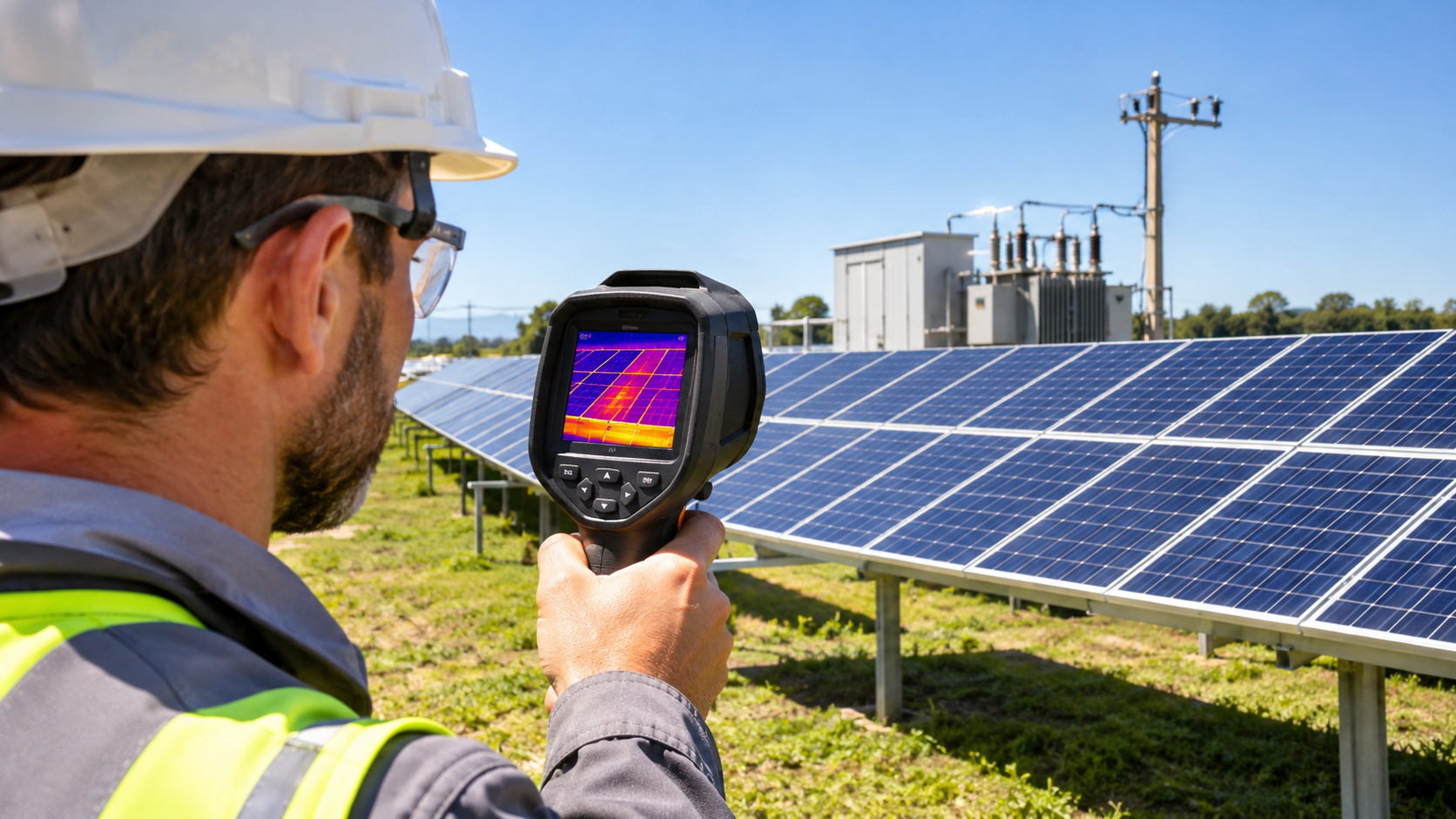
From an engineering perspective, this raises questions about ventilation, heat dissipation, installation conditions, and manufacturer-specified operating limits. From an operational perspective, it requires monitoring records that can distinguish expected performance variations from signs of abnormal conditions.
For economic assessments, the issue extends beyond the cost of replacing damaged components. It is important to investigate whether certain conditions reduce equipment availability or electricity generation before a failure occurs. There is no universally applicable percentage for every power plant: quantifying these effects requires an analysis tailored to the technology and location.
Flooding: the critical vulnerability may lie outside the generation area
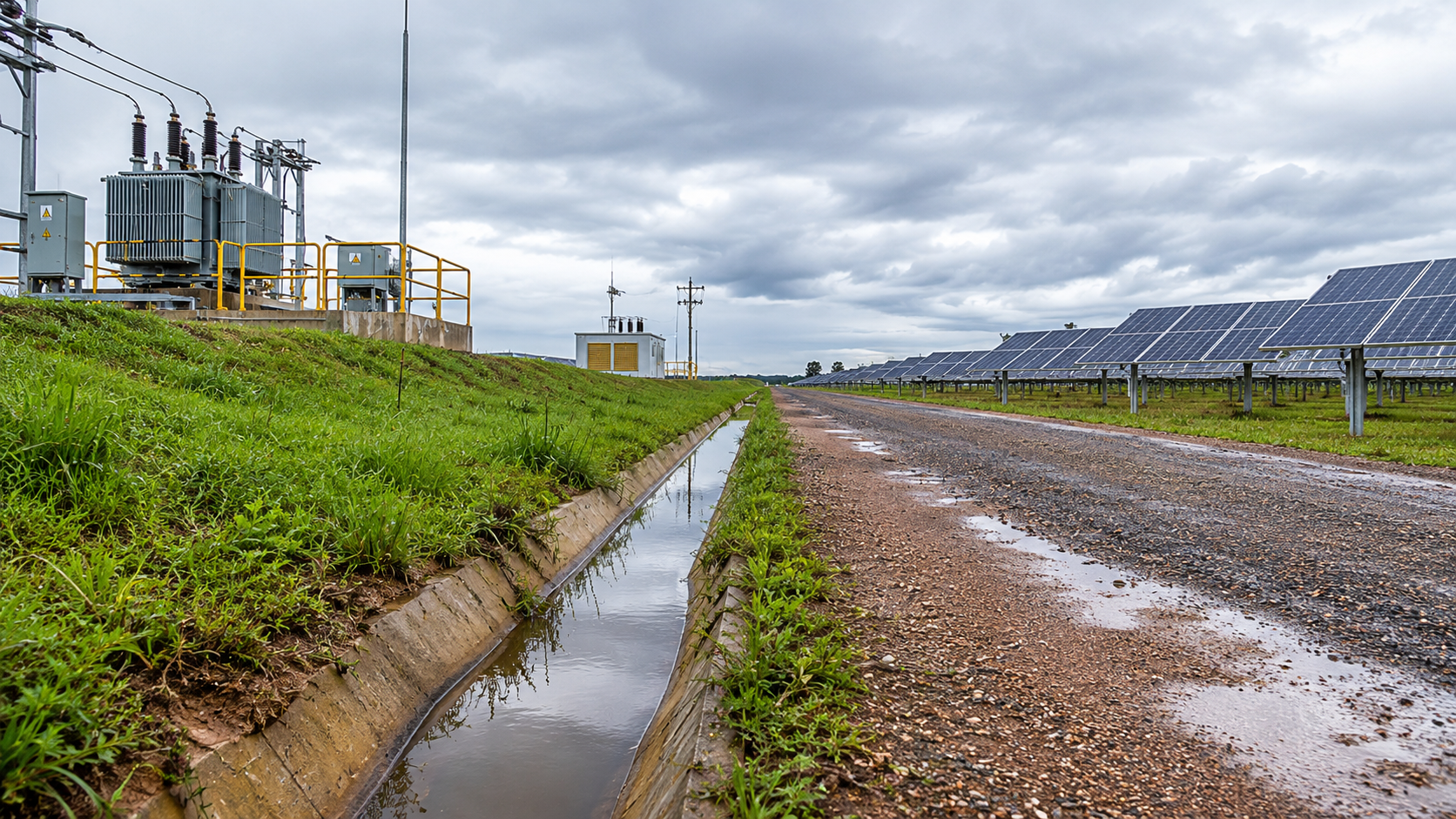
Floodwater can affect infrastructure beyond the visible generating equipment. Electrical systems, auxiliary facilities, and access routes must all be included in the assessment. An NREL technical publication on solar energy and resilience highlights the vulnerability of components beyond photovoltaic modules and the importance of siting decisions in relation to flood risk.
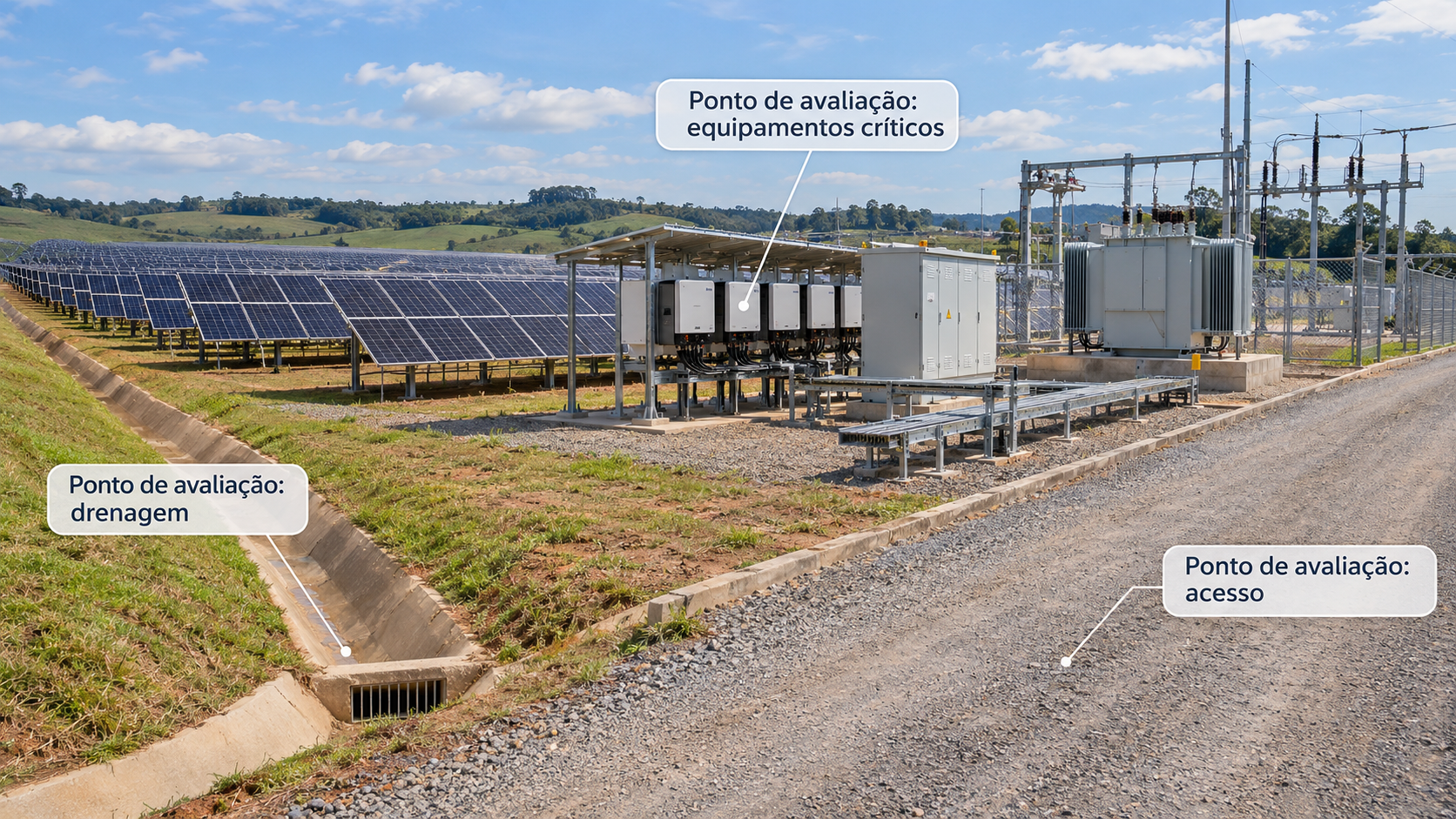
The assessment should include topography, drainage, and the elevation of critical components, supported by surveys appropriate to the project. The presence of a nearby river is relevant information, but it does not provide a complete assessment. Water movement across the site and the condition of access routes also require attention.
For example, a facility may preserve its generating equipment yet still face difficulties bringing repair crews onto the site. These dependencies must be identified before estimating recovery times.
Protective measures should be designed and sized by qualified professionals. Elevating components, modifying the site layout, or redesigning drainage systems are options to investigate, not universal prescriptions. The appropriate decision depends on the flooding mechanism, site characteristics, and the potential consequences of the intervention both within and beyond the project boundaries.
A power plant depends on a network of essential services
An assessment limited to the plant’s physical boundaries overlooks some of its critical dependencies. Electricity, water, transportation, and telecommunications are interconnected systems. In its chapter on risks across sectors and regions, the IPCC discusses how these interdependencies can produce cascading effects.
During project development, this calls for examining the services required to generate and deliver electricity. A facility may depend on a grid connection, an access road, communications infrastructure, or a supply system whose disruption could affect operations.
The question is no longer simply, “Will the equipment withstand the event?” It must also include, “Will the systems required to operate it remain available?” This broader perspective helps prioritize assessments of single points of failure and alternatives that can actually be used when needed.
As an internal planning exercise, project teams can map the sequence from a hazard to a service disruption. If an access road becomes blocked, which activities can no longer take place? If communications fail, which functions can continue operating safely? The answers must reflect the plant’s actual configuration rather than assuming redundancies that exist only in conceptual designs.
Historical records are essential, but they do not tell the whole story
Records of rainfall, temperature, and past events help establish an understanding of local conditions. However, assessing long-lived infrastructure also requires consideration of future conditions and the uncertainties associated with them.
The World Bank, through its climate and disaster risk screening resources, brings together historical datasets and projections to support this process. Screening can identify relevant issues and guide further investigation, but it does not turn regional data into a detailed engineering assessment.
In practice, project documentation should specify which time horizons and scenarios were considered. A maintenance decision for the coming months operates on a different timescale from selecting a site intended to support decades of operation. Combining these horizons without distinction can create a false impression of precision.
It is also advisable to document the limitations of the available information, including spatial resolution, data sources, assumptions, and aspects requiring local investigation. Acknowledging uncertainty does not mean postponing every decision. It means comparing alternatives and understanding whether they remain appropriate when conditions differ from those considered most likely.
Brazil already has a framework for addressing the issue
Climate resilience is also part of Brazil’s national energy planning agenda. On October 14, 2026, the Energy Research Office (EPE) announced its Roadmap for Strengthening the Resilience of Brazil’s Electricity Sector in Response to Climate Change.
According to EPE, the work applies an assessment methodology that considers hazards, exposure, and vulnerability across different scenarios and time horizons. The document outlines strategies for preparedness, response, and recovery, reinforcing that resilience also includes the ability to restore essential functions following disruptive events.
On November 10, 2026, the release of the Environment, Society and Energy Report for Brazil’s Ten-Year Energy Expansion Plan (PDE 2036) again highlighted climate change adaptation among the challenges facing the sector.
These publications provide useful context for business decisions. They should not be presented as evidence that a specific facility is climate-adapted, nor as a uniform new obligation applying indiscriminately to every project. Translating sector-wide planning into project-level decisions requires identifying local hazards, affected components, and measures appropriate to each facility.
Turning climate risk assessments into investment decisions
Start with critical functions
A recommended management approach is to identify which functions must be maintained and which failures would have the greatest consequences. This assessment helps focus attention on components whose unavailability could compromise safety, electricity generation, or recovery.
It also helps prevent measures from being selected solely on the basis of visibility. A major intervention may attract more attention than a relatively minor adjustment to a critical component without necessarily delivering greater benefits. The choice must be supported by the specific risk mechanism identified.
Compare alternatives over the asset’s life cycle
In its Good Practice Note for Energy Sector Adaptation, the World Bank recommends accounting for changing environmental conditions when developing and designing electricity infrastructure. From a business perspective, this supports comparing alternatives before construction decisions restrict the available options.
Initial capital expenditure is only one part of the comparison. Maintenance requirements, replacement needs, plausible disruptions, and recovery conditions should also be considered. The objective is not to assume that every adaptation measure will generate a positive return, but to determine whether a particular intervention can reduce material consequences at a justifiable cost.
Make residual risk explicit
No combination of measures can eliminate every possibility of disruption. An assessment should identify which risks have been reduced and which remain. This documentation supports better decisions than simply describing an asset as “resilient” without explaining what that means.
For an investment committee, it is important to distinguish among completed assessments, approved interventions, and verified outcomes. These represent different stages. The existence of a study does not mean that protective measures have been implemented, and installing a protective system does not, on its own, demonstrate its effectiveness over time.
Preparedness must continue throughout operations
A project may be based on sound assumptions yet gradually lose some of its protection if those assumptions are not reflected in day-to-day operations. For this reason, each measure should be associated with clearly assigned responsibilities, inspections, and review criteria, integrating climate adaptation into the operational management system.
Procedures for alerts, communications, and recovery deserve the same level of attention as physical infrastructure. Teams need to know who assesses conditions, who makes decisions, and what information is required for a safe return to operations. The purpose of drills and exercises is to identify gaps before a real incident occurs.
Potential monitoring indicators include completion rates for critical inspections, remediation of known vulnerabilities, and response times recorded during emergency simulations. These indicators do not demonstrate immunity to extreme events; they help verify whether the preparedness plan is being implemented.
The assessment should also be reviewed whenever significant changes occur, such as plant expansion, modifications to access routes, component replacement, or new information about the site. Risk management must reflect the facility as it actually exists, not merely the version documented in the original assessment.
Physical climate risk must be reflected in economic assessments
For an energy asset, physical climate impacts can affect production, repair costs, and operational continuity. The IEA’s Climate Resilience for Energy Security report, published on November 14, 2022, examines the relationship between climate conditions, energy reliability, and adaptation measures across energy supply systems.
When applying these insights to business decisions, financial models should clearly identify which disruptions have been considered and which costs remain outside the estimates. This makes it possible to assess project robustness without presenting figures that imply a degree of precision unsupported by the available data.
It is useful to compare recovery scenarios and identify which components have the greatest influence on financial outcomes. A component that is difficult to replace may warrant different attention from one that is readily available. This is a recommended analytical approach, not an estimate of potential losses for any particular facility.
The same principle applies to communications with lenders and business partners. Clearly stating which risks have been assessed, which measures are planned, and which uncertainties remain makes those discussions more transparent and verifiable. A commitment to resilience becomes meaningful when it is reflected in decision-making criteria, allocated resources, and ongoing operational monitoring.
Low emissions and operational continuity must go hand in hand
Expanding lower-emission energy sources is an important part of the response to climate change. For these projects to continue delivering their intended benefits throughout their operating lives, the infrastructure must also account for the physical conditions under which it will operate.
The IEA’s observatory and Brazil’s national planning resources broaden access to information and help frame the right questions. However, project-specific decisions still require a detailed understanding of the site, equipment, and operational dependencies.
The critical step is turning information into action: identifying a hazard, understanding its consequences, selecting appropriate measures, and verifying that those measures remain effective. Resilience is built through this sequence of decisions, implementation, and periodic review.
A low-emission power plant helps address the causes of global warming. Preparing it to withstand and recover from climate-related impacts helps preserve its ability to deliver electricity. Both responsibilities belong within the same project.